

Introduction
Creating software for embedded devices requires navigating a highly specialized set of constraints that do not typically affect general-purpose computing. While writing code that functionally executes a task might appear to be a short-term success, the actual engineering challenge lies in building a system that is robust, maintainable, and scalable over a product’s entire lifecycle. Software architecture serves as the fundamental organization of a system, embodied in its components, their relationships, and the principles guiding its design.
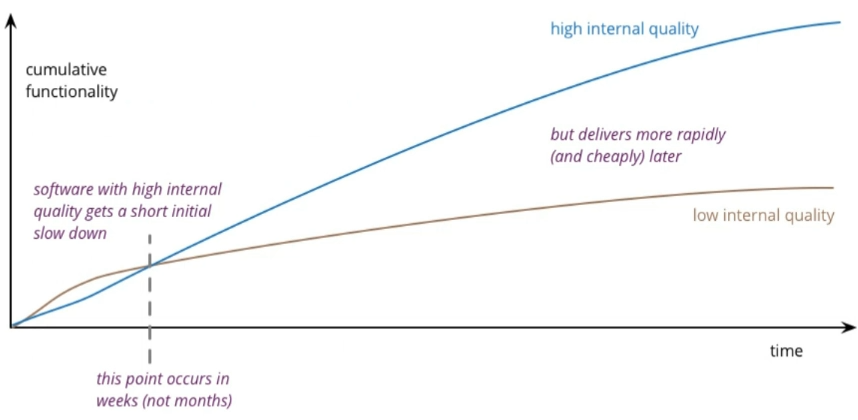
Too often, embedded systems fall victim to “architectural debt,” where rushed design decisions lead to monolithic codebases that complicate testing, restrict innovation, and become extremely difficult to refactor. In this post, we explore the fundamentals of embedded software architecture. By focusing on establishing clear boundaries, evaluating execution models, and analyzing a generic architectural evolution, this guide aims to provide strategies for maintaining clean layered interfaces in C++ and preventing catastrophic system entanglement.
Background / Context
Before evaluating implementation strategies, it is critical to understand why embedded software architecture requires a deliberate approach. The architecture acts as the shared knowledge base among developers, dictating how a solution is built and preventing ad-hoc decisions that are costly to reverse.
Unlike standard computing environments, critical embedded systems operate under tight physical constraints, forming a constant “trade-off triangle” consisting of limited memory space, strict energy budgets, and deterministic real-time processing requirements.
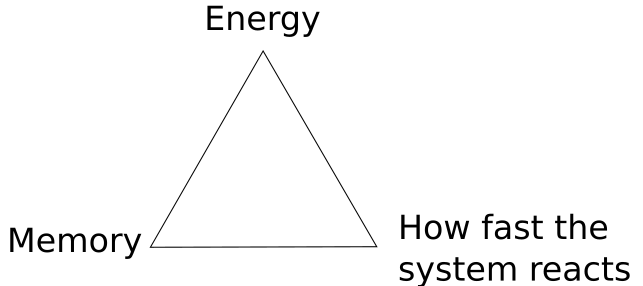
For instance, increasing processing capability to meet a timing deadline generally requires more energy, which directly impacts the battery life and thermal constraints of the hardware. Furthermore, modern embedded systems have evolved from isolated, single-function units into connected, distributed edge computing networks. This connectivity introduces rigorous requirements for data integrity, cybersecurity, and graceful scalability over time.
Main Content / Code Explanation
Step 1: Identifying the Right Architectural Pattern
Selecting an appropriate architectural pattern depends heavily on system complexity and the specific constraints of the target hardware.
• Layered Architecture: This is the standard pattern for isolating hardware specifics from business logic. It segregates responsibilities into a Hardware Abstraction Layer (HAL), platform services, domain logic, and an application layer.
• Client-Server & Microservices: As embedded devices become highly connected, patterns utilizing a client-server or publish/subscribe model (like OPC or MQTT) allow systems to share data seamlessly across local networks or cloud environments.
• Event-Driven: This pattern triggers program flow based on internal or external occurrences, such as sensor interrupts. It is highly efficient for low-power devices, as it keeps the CPU in sleep modes until an event mandates processing.
Step 2: Choosing an Execution Model
The architectural foundation dictates how tasks are scheduled and resources are managed, which fundamentally impacts real-time determinism.
• Bare-Metal: Operating without an OS, this approach provides absolute control over hardware and minimal memory footprint, relying on a main loop and Interrupt Service Routines (ISRs). It is highly performant but notoriously difficult to scale for complex, concurrent tasks.
• RTOS (Real-Time Operating System): Systems like FreeRTOS or Zephyr provide a lightweight kernel for preemptive multitasking, guaranteeing deterministic response times for time-critical applications. The trade-off is a slight increase in memory usage and context-switching overhead.
• Embedded Linux: Utilized for high-end applications requiring complex networking or rich user interfaces, Embedded Linux offers massive scalability but demands powerful processors (e.g., Cortex-A) and lacks native hard real-time determinism without specialized patches.
Step 3: Real-World Architecture Evolution (A General Example)
To observe how architectures must adapt to changing requirements, consider a generic industrial fluid mixing system.
In its initial iteration, such a system might employ a monolithic design where the central controller communicates with various pumps, sensors, and valves via direct point-to-point UART serial connections. As production scales and the system demands integration with predictive maintenance analytics, the direct UART connections create a bottleneck.
To resolve this architectural debt, an engineering team might migrate the communication layer to a modern Client-Server architecture using protocols like OPC or MQTT.
• This architectural shift abstracts the hardware into an object-oriented data model, allowing the embedded system to securely interface with cloud-based AI analytics without tightly coupling the hardware to the network stack.
• Connections to external services leverage HTTPS with SSL certificates (public/private keys) to encrypt data, while API tokens manage access control.
• The embedded server remains behind a local network firewall, isolating the critical control loop from public internet vulnerabilities.
Step 4: Enforcing Layer Boundaries in C++
A frequent point of failure in layered embedded architectures occurs when developers bypass intermediate abstractions for immediate convenience.
Consider a layered architecture consisting of a HighLevelService (HLS), a Model, and a LowLevelService (LLS). The architectural rule is that the HighLevelService should only interact with the Model. However, a developer might bypass the Model and directly #include the LowLevelService into the HighLevelService to fetch data faster:
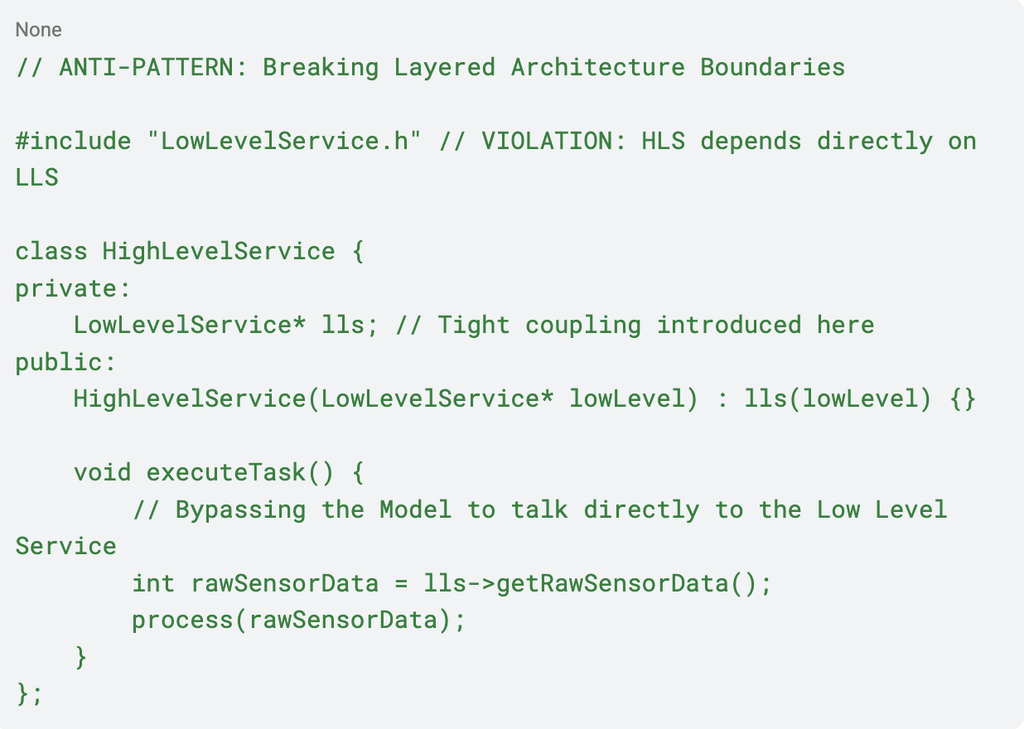
Why this approach is detrimental: Direct dependencies destroy code reusability. Attempting to reuse HighLevelService in a new project forces the inclusion of LowLevelService and its specific hardware drivers. Furthermore, skipping the Model prevents it from tracking state changes, which in multithreaded systems can cause asynchronous data mismatches and critical synchronization bugs.
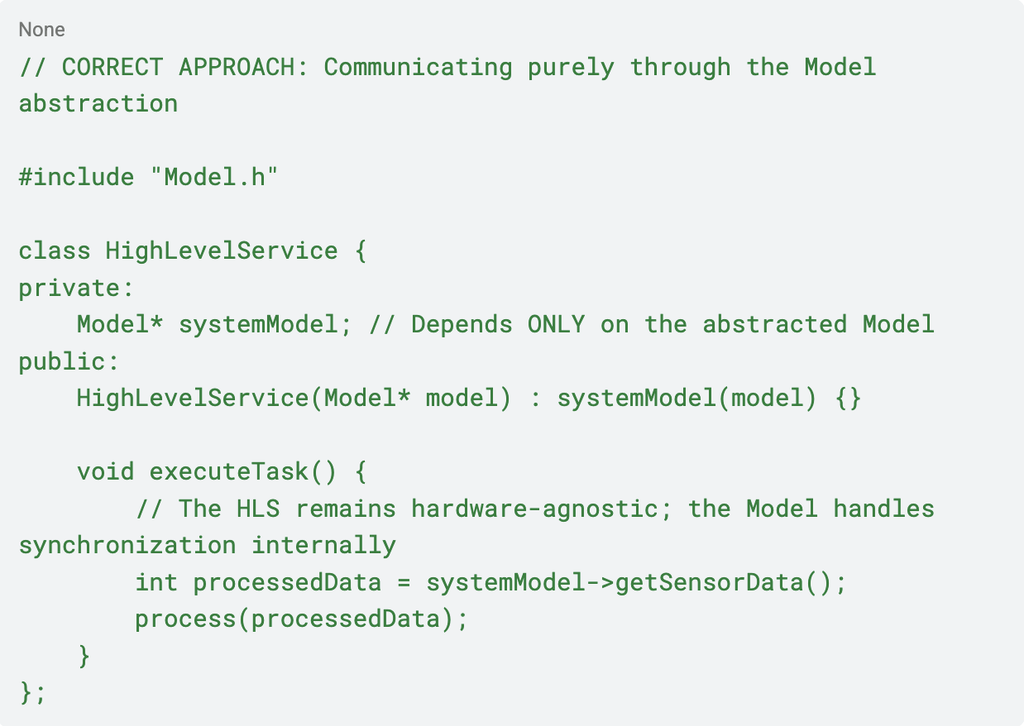
The Solution: Maintain strict boundaries. Instead of creating direct links, extend the Model layer to pass the necessary data upward.
Conclusion
In this post, we have examined the core fundamentals of embedded software architecture. Managing the trade-offs of processing speed, memory, and energy requires carefully choosing between execution models like Bare-Metal and RTOS. By looking at a generalized system migrating to a client-server model, we see how architectures must evolve to meet connectivity demands safely. Most importantly, enforcing strict boundary layers in your C++ code prevents tight coupling, keeping your system scalable and testable. Taking the time to structure your software correctly upfront can prevent months of dealing with complex architectural debt.
Additional Tips
• Plan Before You Code: Taking the time to diagram component interactions and architectural boundaries before writing code can prevent the generation of unmanageable dependencies.
• Data Dictates Design: Adopt the principle that “there is no hardware, only data”. Focus on defining clear data flows and push hardware-specific register interactions to the absolute edges of the system through abstraction layers.
• Use Architecture Decision Records (ADRs): Maintain a log of architectural decisions, context, and trade-offs. ADRs serve as a crucial historical record to explain why a system is structured a certain way to new developers joining the team.
• Leverage 4C Modeling: Utilize Context, Containers, Components, and Code diagrams to visualize your system hierarchically, ensuring that implementation aligns with architectural intent.
Bibliography
• Martin Fowler OSCON 2015
• https://www.technologyandstrategy.com/news/embedded-systems
• https://www.beningo.com/transform-your-embedded-software-architecture-with-these-powerful-practices/
Written by Edwin Barragan
Edited by Adrian Evaraldo
For further inquiries, contact us: info@emtech.com.ar